
Share this
by Admin on Feb 25, 2026 5:02:23 PM
After growing Stratasan from startup to a nine-figure exit, Jason Moore and Haley Devlin discovered that the operating system they started with stopped working at scale. Now they help other founders navigate the same transition from founder-led chaos to senior leadership team execution.

Most founders think scaling means choosing between speed and structure, between entrepreneurial energy and operational discipline. Jason Moore and Haley Devlin proved that's a false choice and built a company that embodied both.
Stratasan, a Nashville-based healthcare technology company, started like most startups: fast-moving, founder-driven, making decisions on instinct. But as they grew, that approach started breaking down. Meetings multiplied without producing clarity. The founder became the bottleneck. Culture became harder to maintain.
Then they adopted what would become the System & Soul framework, and everything changed. Within three years, they'd built a scalable platform, unified their leadership team, and created a culture so strong that employees would "run through a brick wall" for the company.
They sold Stratasan in 2022 for nine figures.
Now, as partners at DNA Partners, Jason and Haley help other growth-stage founders navigate the same transition they lived through: how to build structure without killing momentum, how to empower a senior leadership team, and how to scale culture intentionally.
Here's exactly how they did it, and what they learned about the gap between startup mode and sustainable growth.
Hello! Who are you and what did you build?
Jason: I'm Jason Moore, former Visionary and CEO at Stratasan. We were a healthcare technology company based in Nashville. I co-founded the company and led it through significant growth before we sold in 2022 for nine figures.
Haley: I'm Haley Devlin, and I was the Operator and COO at Stratasan. I saw the company go from sub-20 employees to over 100, and it was the most gratifying experience of my professional life.
Now we're both partners at DNA Partners, where we help other founders implement the System & Soul framework, which transformed our company.
What was the pivotal moment that made you realize you needed to change?
Haley: We had a board meeting that I'll never forget. It was one of those board meetings where you need to go for tequila afterwards... and not the celebratory kind.
What we heard from our investment team was that we had to grow up. We were a startup, and we were behaving like a startup. We were making decisions like a startup. We were spending money like a startup. And we had to grow up if we wanted to be a scalable platform.
That hit hard. We spent a lot of time thinking about how to create a scalable platform as a leadership team. And our partnership with our coach Benj, and eventually System & Soul provided the foundation upon which we could build that platform.
Jason: We'd been running on EOS before that, which worked for a while. But we started feeling like we were hitting our heads against the ceiling. The system hadn't evolved. Tools like "rocks" (their quarterly goal system) just stopped working for us.
We needed something that would scale with us and not just give us a rigid framework to follow.
How did you find System & Soul?
Jason: In Q1 of 2020, we began searching for an EOS Implementer and reconnected with Benj Miller, who had been my neighbor 20 years earlier. I’d heard he had become a facilitator, so we brought him in and a lot changed.
I was told we actually had the privilege of being the first System & Soul client ever. So we lived through the evolution of the framework alongside Benj.
Haley: We were running well on EOS, and when Benj introduced System & Soul, I realized as the operator that something had been missing. What we built in those last three years at Stratasan, a team of about 100 people who would run through a brick wall for the company, wasn’t created by the system alone. It came from the soul part.
We had created, very intentionally and on purpose, this really strong, supportive, highly collaborative culture. Bringing the soul part in lit us on fire. It felt like, "Okay, this is what we need. This is what's gonna get us to the next level."
What specific System & Soul tools transformed your company?
Haley: The Culture Equation was the most impactful tool for us. It profoundly changed our organization.
The reason it was so impactful was because it gave me, as an operator, tangible, concrete ways to bake the culture we wanted into the organization. We took the habits from the Culture Equation and essentially extrapolated them through all areas of the company.
If you take your core values and pair them with habits in that area, you will create the culture you want. In the same way, when you apply consistent habits to your leadership and management, the things you do day in and day out, you will build an empowered leadership team.
We basically blew up this concept of habits and applied it across different areas of the business. It truly made every day feel like the muscle memory for our employees was in place so that things didn't feel as hard.
Jason: You didn't have to work so hard to understand expectations. Zoom meeting etiquette? Those are written down. We have a habit to go over expectations for meetings in the onboarding process.
When people's expectations are clear and they understand what's expected of them and how we do things here, it makes running the operation easier.
Can you give us examples of specific habits you created?
Jason: One of our best cultural habits was something called "Donuts." During COVID, we went from being an in-office company to fully remote virtually overnight. We started hiring people all over the country.
We got a Slack plugin called Donuts. It's the simplest thing. Doesn't cost a lot of money. But it was probably the most impactful thing for our culture that we did.
The app pairs people at random to have a 30-minute call every two weeks. There's only one rule: you do not talk about work. The channel also encourages people to post a selfie. People would post summaries of what they talked about.
It was the best. Talk about human dignity in the workplace. It sparked real conversations.
Another huge one was "Second Fridays." When we got acquired, they did a poll about our benefits. The number one most cherished benefit we had was Second Fridays. Basically, the second Friday of every month, everyone got off with no PTO. Somebody from each department was on call so everything was covered.
We had unlimited PTO, but this was different. Why? Because when you take PTO, the rest of your team is working. When everybody's off, you really don't think about it. People were encouraged to take a picture of whatever they did and post it in a Slack channel. It was celebrated.
Job Descriptions as Performance Review Tool: Haley and our director of HR created this one. We used the job description as a template for what people are responsible for doing. We deconstructed everybody's job description, and then we "red, yellow, greened" how people are performing against each bullet point. This happened every quarter.
The manager would fill it out for the employee, and the employee would fill it out for themselves. Seeing misalignments was really helpful. But here's the key: it wasn't a rating on the employee themselves. It was a rating on our ability as an organization to best support this employee to do what we say they're supposed to do.
A red rating on a particular bullet point could mean that person has too much on their plate. When we left, with around 100 employees, they knew what they were supposed to be doing and they knew how they were gonna be deemed successful.
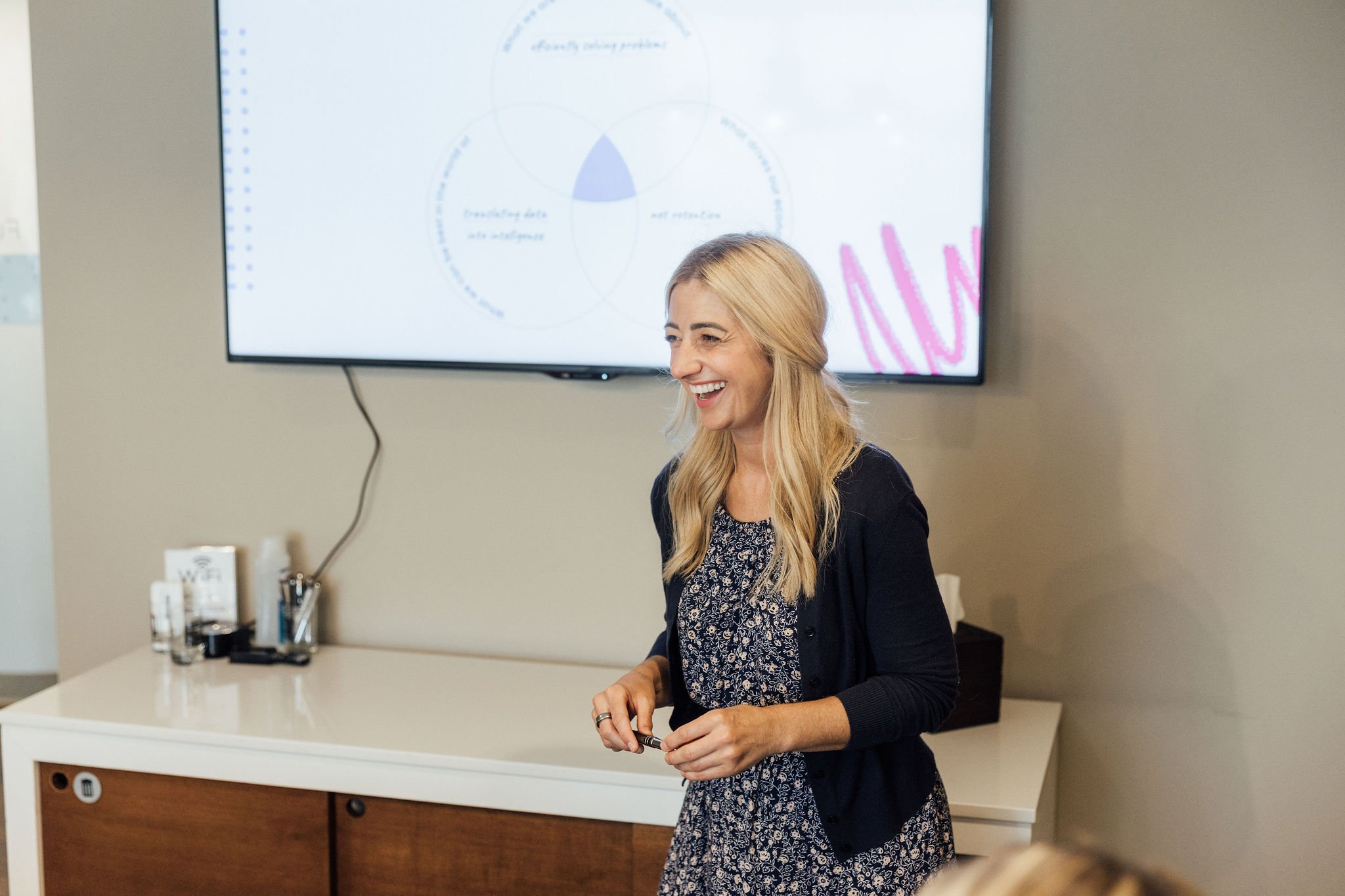
How did you transition from founder-led to senior leadership team-led?
Jason: This is critical. Haley wasn't a founder, but she was leading the company. We were a senior leadership team because Haley was leading.
It got to a point where I wasn't included in anything. Not because I wasn't trying. I was getting kicked out, like truly kicked out of meetings. I was told that I was actually a distraction at this point and that they were going to be doing things differently now.
We're now using S2 Sync to help leadership teams establish the same kind of rhythm and accountability that allowed us to make this transition successfully.
Going from founder-led to senior leadership team-led is a lot less offensive to me as a founder than breaking founder habits, because the founder's habits were good. They took us from zero to $1 million to 10 clients to $3 million.
But at some point, founder habits have to evolve into organizational habits.
Haley: As the operator, System & Soul gave me the tools to lead confidently. It wasn't just theory. It was practical frameworks I could implement every day. The habits, the rhythms, and the accountability structures empowered me to run the business while Jason focused on vision and strategy.
What were some challenges you faced implementing this framework?
Jason: One area we struggled with initially was coming up with our Objectives and Key Results. We struggled to get buy-in at the bottom of the organization because we would go into this big cool offsite every quarter, come up with these things, and then tell the company, "Here's what we're all focusing on."
It was our coach's suggestion to do a bit of a bottom-up model. Every quarter, I would facilitate sessions with our middle management layer and say, "Hey, we want to hear from you what's going on in your organization. If you could create a company objective and key results, what would it be?"
I collected all of this data and pushed it up to the senior leadership team. We had those inputs going into our conversations, and more importantly, it made people feel like they had a voice there.
Haley: Rocks never actually worked for us. We failed at that consistently. We never were able to fit in that box. Objectives and Key Results, on the other hand, were invented by a software company and felt more natural for us. The shift in framework helped, but also our coach staying one step ahead of us made a huge difference.
What's your advice for other operators and senior leadership team members?
Haley: Stop pretending alignment and start earning it. Too many leadership teams confuse polite head-nodding with real cohesion, and that’s how misalignment quietly compounds. If you don’t understand something, say it. If you disagree, risk saying it. If you’re stuck, ask for help, because the fastest way to weaken a team is to protect your ego instead of the outcome. The strongest SLTs I’ve seen aren’t the ones who avoid tension. They’re the ones who handle it honestly, with curiosity and empathy, and come out clearer on the other side.

Now that you've exited, what are you building at DNA Partners?
Jason: We help other founders navigate the same transition we experienced. We call it the Momentum Paradox, the reality that more growth often brings more complexity.
Founders find themselves asking:
- How do we scale without losing what makes us unique?
- How do I get out of daily firefighting without losing control?
- How do I empower my team to lead, not just execute?
Haley: At DNA Partners, we implement the System & Soul framework through a rhythm of facilitated workshops and ongoing alignment. We start with a 3-day leadership team workshop where we align teams around five key areas:
- Structure: Define your org chart so everyone knows who owns what
- Scoreboard: Identify the key metrics that matter most
- Quarterly Objectives: Turn vision into actionable 90-day goals
- Team Cadence: Establish meeting rhythms that drive accountability
- One-Page Strategic Plan: Capture vision, strategy, values, and goals in one place
Then we maintain momentum with quarterly strategy sessions and monthly accountability meetings.
What makes System & Soul different from other operating systems?
Haley: From an operator perspective, I feel System & Soul is continuously evolving just like a company, just like an employee does. The employment market is very different now. We're appealing to workers today that don't think like workers thought 15, 20, 25 years ago.
System & Soul speaks to today's workforce. The Engagement Index, along with the cultural tools, is designed for how people truly want to work today.
Jason: System & Soul brings structure without rigidity. It gives teams the tools to see both the operational reality of the business and the human dynamics that drive it.
Most operating systems focus only on the System (the metrics, the meetings, the accountability). But they miss the Soul. The culture, the purpose, the human relationships that make people actually want to show up and do great work.
You need both.
What would you say to founders who are hitting that growth ceiling?
Jason: If you're feeling like decisions still bottleneck at you, if your team is executing but not leading, if culture is getting harder to maintain as you grow, you're not alone. That's the natural byproduct of growth.
What got you here won't get you there. Intuition alone won't scale. You need a framework that combines System (structure, accountability, data) with Soul (people, purpose, culture).
Haley: You need someone outside the system. You need someone who is not embedded in the politics, history, or emotion of it, but someone who can see what you can’t. An objective voice brings perspective when you’re too deep in the weeds, calls out the drift before it becomes damage, and holds you accountable to what you said actually matters. The right coach isn’t there to cheerlead. They’re there to spot the blind spots, ask the uncomfortable questions, and keep the team focused on the bigger picture when the day-to-day noise starts to take over.
That's what we do at DNA Partners. We've lived this transition. We've scaled a company from startup chaos to nine-figure exit.And now we help other founders build structure without slowing their momentum.
What's your vision for the companies you work with?
Haley: We want to help leadership teams regain freedom from constant firefighting, confidence in their team's capacity, and energy to lead with clarity.
When both the System and the Soul are in sync, companies operate with focus and intentionality. Leaders gain the confidence to delegate. Teams align around measurable outcomes. And the business moves forward without constant course correction.
Jason: We're not theorists or career consultants. We've built, led, and exited companies. We understand the real challenges of scaling something that matters.
If you're ready to bring structure to your growth without losing what makes you unique, we'll help you build a business with both system and soul.
Where can people learn more?
If you're a founder hitting the growth ceiling and feeling like you're the bottleneck, struggling to empower your leadership team, or watching culture drift as you scale, there are a few ways to work with us:
Work with DNA Partners directly to implement the System & Soul framework with your leadership team: dnapartners.org
Train as a System & Soul certified coach to bring this framework to other founders: systemandsoul.com/coach
Explore free resources to start building structure today: systemandsoul.com/free-resources
The Bottom Line:
Scaling isn't just an operational challenge. It's a shift in how you lead. What got you from zero to $3M won't get you to $30M. You need structure that creates clarity, accountability that empowers teams, and culture that scales with intention.
If a healthcare tech company can go from startup chaos to nine-figure exit by balancing system and soul, your company can too.
-1.png@width=2000&height=500&name=Untitled%20design%20(48)-1.png)
Personally, I find that leading a high-growth company can be exhilarating when you have the right structure in place. But without it, it's isolating, exhausting, and unsustainable.
Because let's be honest, if you're the founder, everyone's asking you questions and expecting you to have all the answers, all the time.
But what about the difficult questions you have as you scale? The strategic decisions that keep you up at night? The feeling that you're the only one who can see where the company needs to go?
This is where System & Soul comes in.
Running a scaling company means everyone expects you to figure it out alone. But what if you didn't have to? System & Soul transforms founder-led chaos into senior leadership team execution, with clear structure and intentional culture.
Work with a coach • Train your leaders • Become certified • Free resources
No Comments Yet
Let us know what you think